# Writing a plugin
For developers
A plugin is a separate class library that GrandNode discovers at startup and that an administrator installs, configures and uninstalls from the admin panel. Payment methods, shipping rate calculators, tax providers, widgets, discount rules, external login providers, exchange-rate sources and storefront themes are all plugins. This article walks through the files every plugin needs, using the shipped `Payments.CashOnDelivery` plugin as the reference.
### Structure
```
src/Plugins/Payments.CashOnDelivery/
Payments.CashOnDelivery.csproj
Manifest.cs plugin identity
CashOnDeliveryPaymentDefaults.cs system name, resource keys, URLs
CashOnDeliveryPaymentSettings.cs ISettings, persisted per store
CashOnDeliveryPaymentProvider.cs IPaymentProvider
CashOnDeliveryPaymentPlugin.cs BasePlugin: install / uninstall
StartupApplication.cs DI registration
EndpointProvider.cs routes, when the plugin has pages
logo.jpg shown in the plugin list
Controllers/ storefront controllers
Areas/Admin/Controllers/ configuration screen
Areas/Admin/Views/
```
Name the project after its system name, using the group prefix of the plugin type: `Payments.X`, `Shipping.X`, `Tax.X`, `Widgets.X`, `DiscountRules.X`, `Authentication.X`, `ExchangeRate.X` or `Theme.X`. The system name is the plugin's persisted identity and must not change after release.
### The project file
```
true
false
..\..\Web\Grand.Web\Plugins\Payments.Example\
$(OutputPath)
..\..\Web\Grand.Web\Plugins\Payments.Example\
$(OutputPath)
Always
```
- `Grand.Plugin.props` adds references to the core projects with `Private=false`, so host assemblies are not copied next to the plugin. Add NuGet packages without a version: versions are managed centrally in `Directory.Packages.props`.
- Set the output path for **both** Debug and Release. A missing Release path makes the plugin disappear from release builds and Docker images.
- Use `Microsoft.NET.Sdk.Razor` when the plugin has views. The views are compiled into the plugin DLL.
### The manifest
```
using Grand.Infrastructure.Plugins;
using Payments.Example;
[assembly: PluginInfo(
FriendlyName = "Example payment",
Group = "Payment methods",
SystemName = ExamplePaymentDefaults.ProviderSystemName,
Author = "Your company",
Version = "1.0.0"
)]
```
`Group` decides where the plugin is listed; use an existing group name: `Payment methods`, `Shipping rate`, `Tax providers`, `Widgets`, `External authentication`, `Discount rules`, `Exchange rate` or `Themes`. `SupportedVersion` is normally left out: it is resolved from the `Grand.Infrastructure` version the plugin was compiled against, and the admin refuses to install a plugin built for another major.minor version of GrandNode.
Keep the identity in one defaults class and reference it everywhere:
```
public static class ExamplePaymentDefaults
{
public const string ProviderSystemName = "Payments.Example";
public const string FriendlyName = "Payments.Example.FriendlyName"; // a resource key
public const string ConfigurationUrl = "/Admin/PaymentExample/Configure";
}
```
### BasePlugin: install and uninstall
The plugin class derives from `BasePlugin`. `Install` seeds default settings and localization resources; `Uninstall` removes exactly what `Install` added. Call `base.Install()` and `base.Uninstall()` last: they record the plugin in `App_Data/InstalledPlugins.cfg`.
```
public class ExamplePaymentPlugin(
ISettingService settingService,
IPluginTranslateResource pluginTranslateResource)
: BasePlugin, IPlugin
{
public override string ConfigurationUrl() => ExamplePaymentDefaults.ConfigurationUrl;
public override async Task Install()
{
await settingService.SaveSetting(new ExamplePaymentSettings { DisplayOrder = 1 });
await pluginTranslateResource.AddOrUpdatePluginTranslateResource(
ExamplePaymentDefaults.FriendlyName, "Example payment");
await pluginTranslateResource.AddOrUpdatePluginTranslateResource(
"Plugins.Payments.Example.ApiKey", "API key");
await base.Install();
}
public override async Task Uninstall()
{
await settingService.DeleteSetting();
await pluginTranslateResource.DeletePluginTranslationResource(ExamplePaymentDefaults.FriendlyName);
await pluginTranslateResource.DeletePluginTranslationResource("Plugins.Payments.Example.ApiKey");
await base.Uninstall();
}
}
```
A settings class is a plain class implementing `ISettings`. GrandNode registers settings classes in dependency injection, so a provider can take `ExamplePaymentSettings` in its constructor and gets the values for the current store.
### Registering services: IStartupApplication
```
public class StartupApplication : IStartupApplication
{
public void ConfigureServices(IServiceCollection services, IConfiguration configuration)
{
services.AddScoped();
}
public int Priority => 10;
public void Configure(WebApplication application, IWebHostEnvironment webHostEnvironment) { }
public bool BeforeConfigure => false;
}
```
Nothing in `Grand.Web` mentions the plugin; the class is found by assembly scanning. A plugin's startup class runs only while the plugin is installed. That is why installing or uninstalling from the admin stops the application: the host (IIS, a Windows service, systemd or Docker) starts it again with the new registrations.
### A configuration screen
When the plugin has settings, add an admin controller under `Areas/Admin`. Load and save the settings for the store selected in the admin store switcher, so each store can have its own values:
```
[AuthorizeAdmin]
[Area("Admin")]
[PermissionAuthorize(PermissionSystemName.PaymentMethods)]
public class PaymentExampleController(
ISettingService settingService, IAdminStoreService adminStoreService) : BasePaymentController
{
public async Task Configure()
{
var storeScope = await adminStoreService.GetActiveStore();
var settings = await settingService.LoadSetting(storeScope);
return View(new ConfigurationModel { ApiKey = settings.ApiKey, ActiveStore = storeScope });
}
[HttpPost]
public async Task Configure(ConfigurationModel model)
{
if (!ModelState.IsValid) return await Configure();
var storeScope = await adminStoreService.GetActiveStore();
var settings = await settingService.LoadSetting(storeScope);
settings.ApiKey = model.ApiKey;
await settingService.SaveSetting(settings, storeScope);
await settingService.ClearCache();
return await Configure();
}
}
```
Views under `Areas/Admin/Views` need their own `_ViewImports.cshtml` (tag helpers and `@inject LocService Loc`) and a `_ViewStart.cshtml` with `Layout = ""`; the admin supplies the page shell. If store managers should configure the plugin too, add the same screen under `Areas/Store`, otherwise the **Configure** link in the store manager panel returns 404.
### Build and install
1. Build the plugin: `dotnet build src/Plugins/Payments.Example`. The output lands in `src/Web/Grand.Web/Plugins/Payments.Example`.
2. Start the site and open **Plugins → Local plugins** in the admin panel. Click **Reload list of plugins** if the site was already running.
3. Click **Install** next to the plugin. The application restarts.
4. Click **Configure**, then enable the provider where its type requires it (for example under **Configuration → Payment → Payment methods** for a payment method, or **Plugins → Widgets** for a widget).
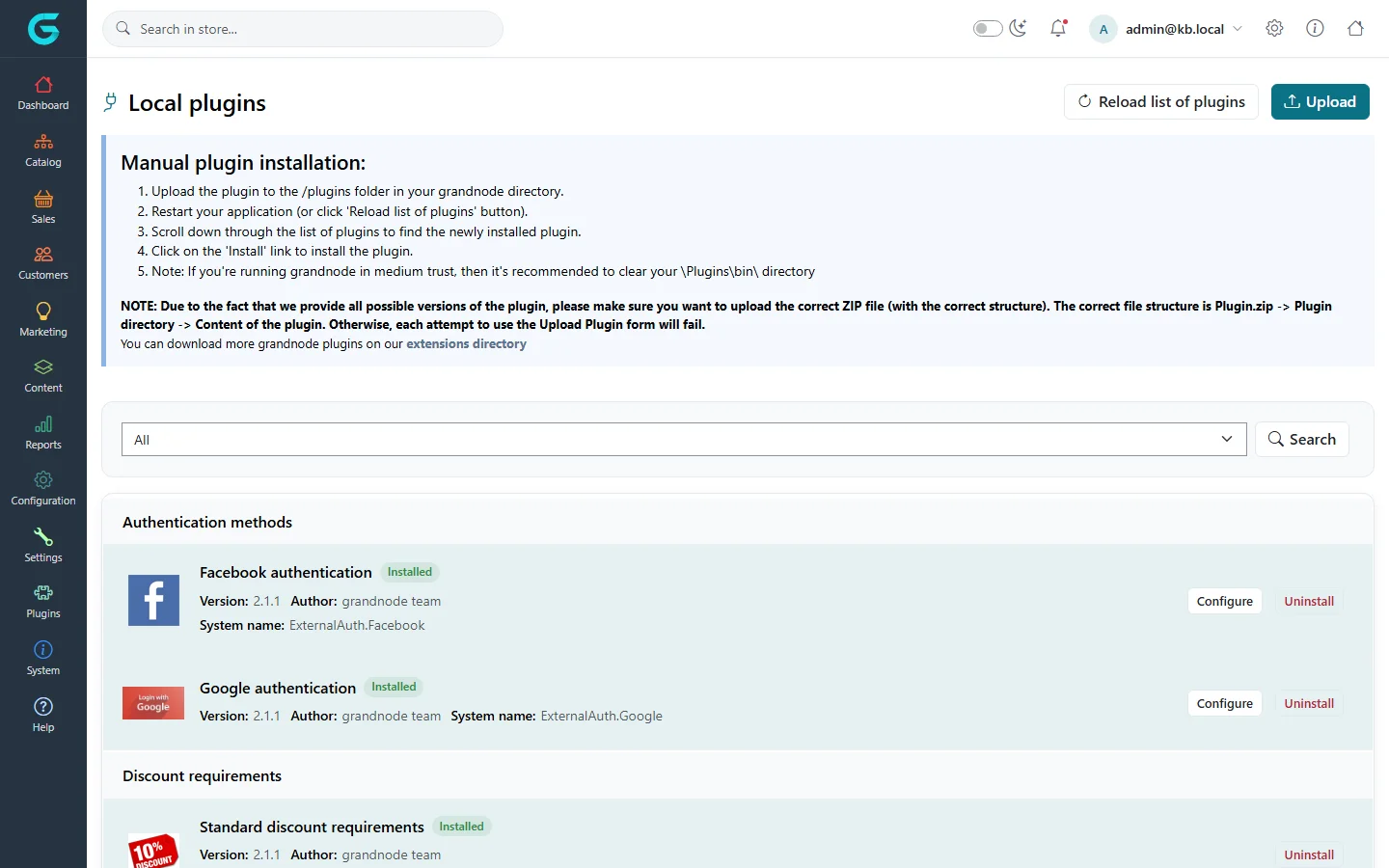
Plugins → Local plugins: every plugin found in the Plugins folder, grouped by its manifest Group, with its version, author and system name.
On a server without source code, a packaged plugin can be uploaded as a ZIP with the **Upload** button (`Plugin.zip` → plugin folder → plugin files), unless `Extensions:DisableUploadExtensions` is set.
### Tips and common mistakes
- The manifest `SystemName`, the provider's `SystemName` and the output folder must be identical.
- `FriendlyName` should be a resource key resolved through `ITranslationService`, so operators can translate it.
- Every resource and setting added in `Install` must be removed in `Uninstall`.
- Never put secrets in code or in the manifest; keep them in settings or configuration.
- Store data in your own collection with `IRepository`; your entity derives from `BaseEntity`.
### Related
- [Plugin provider types](https://grandnode.com/developers-plugin-provider-types) — payment, shipping, widget and discount rule contracts.
- [Creating a theme](https://grandnode.com/developers-creating-a-theme)
- [Upgrade migrations](https://grandnode.com/developers-upgrade-migrations)
- [Web page](https://grandnode.com/developers-writing-a-plugin)